Podcasting for Chicago-area organizations

Solo creator guides don't answer the questions a small law firm or consulting practice actually has. This section does.

The business podcast is a different animal

A solo creator building an audience from zero has different technical priorities than a professional services firm using a podcast to communicate with existing clients. The audience size expectations are different. The episode production cadence is different. The equipment budget conversation is different.

A firm with two partners who both want to be heard on the podcast has a multi-host setup question that doesn't come up in most guides. A business that wants to interview clients or referral partners needs a reliable remote recording setup more than a solo creator who scripts their own content.

The guides in this section address the configuration questions that arise specifically from a business context.

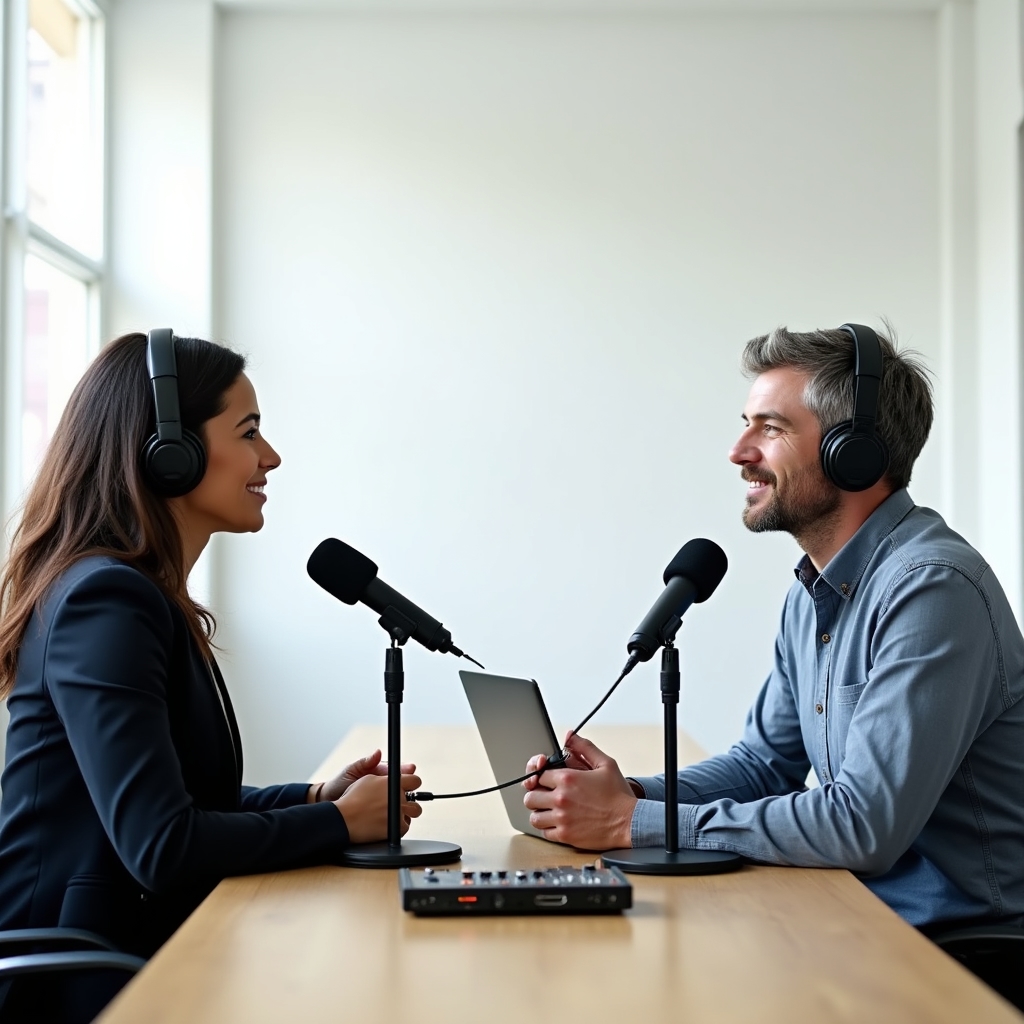
Two professionals at a small business recording a podcast episode together at a shared desk with microphones

What local businesses actually need to know

Multi-Host Setup

Recording two or more hosts in the same room requires either multiple USB microphones (with the latency and driver coordination that entails) or an audio interface with multiple XLR inputs. The audio interface route is more reliable and produces better results when the budget allows for it.

The Focusrite Scarlett 2i2 handles two XLR microphones and connects via USB. Combined with two cardioid dynamic microphones, this represents a two-person studio setup that produces professional results. The total equipment cost is in the $250-$350 range depending on microphone selection.

Equipment

Episode Frequency for Business Podcasts

Monthly episodes are sustainable for most professional services firms. Bi-weekly is achievable if the production workflow is efficient. Weekly is a production commitment that requires either significant time allocation or delegation.

The 30-minute edit workflow described in Tool Breakdowns is designed for monthly or bi-weekly cadence. At weekly frequency, batching multiple episodes in a single recording and editing session on a set day becomes worth considering.

Workflow

Audience Size Expectations

A business podcast serving an existing client base or professional community does not need download numbers comparable to general-audience podcasts. A firm whose clients number in the hundreds can have a podcast that reaches exactly those clients and achieve its intended purpose.

Setting realistic expectations about download numbers before launch prevents the common pattern of abandoning a podcast after three episodes because "nobody is listening." The relevant measure for a business podcast is whether the intended audience is listening, not whether the podcast is growing rapidly.

Strategy

Conference Room Recording

Most conference rooms are acoustically poor recording environments. Hard surfaces, glass walls, and HVAC noise are the three recurring problems. The fixes are temporary and low-cost: moving heavy chairs and soft furnishings to the table, hanging moving blankets on windows and hard walls, and scheduling recordings when HVAC cycles are between active periods.

A cardioid dynamic microphone positioned close to the speaker's mouth (four to six inches) rejects much of the room's ambient character. Dynamic microphones are less sensitive to room reflections than condenser microphones. For conference room recording specifically, the dynamic microphone type has a practical advantage over condensers regardless of price point.

Environment

A two-person business podcast setup

This is one configuration that produces reliable results for a two-host business podcast. Not the only configuration. Not the cheapest possible configuration. A reliable starting point.

01

Audio Interface

Focusrite Scarlett 2i2 (3rd gen or later). Two XLR inputs, USB-C connection, plug-and-play drivers on Mac and Windows. Handles gain staging reliably without technical expertise.

~$120
02

Microphones (x2)

Shure SM7B is the recognizable choice at $400 each. The Audio-Technica AT2005USB (dynamic, XLR/USB) at $60-80 each performs comparably for spoken word in typical room conditions. Two AT2005USB units fit within the budget that one SM7B would consume.

$60-400 each
03

XLR Cables (x2)

Six-foot XLR cables. Cable brand does not meaningfully affect audio quality at podcast recording distances. Cables from any established cable manufacturer work identically.

$10-15 each
04

Microphone Stands (x2)

Desktop boom arms position the microphone at the correct distance from the speaker's mouth without requiring them to lean forward or hold the microphone. The Rode PSA1 is a reliable option. Generic alternatives from RĂ˜DE or Heil work at lower price points.

$30-100 each
05

Headphones (x2)

Closed-back headphones for monitoring during recording. Sony MDR-7506 are the standard reference at $100 each. Any closed-back headphone at $30+ that doesn't bleed sound into the microphone works for podcast monitoring purposes.

$30-100 each

Questions about your specific setup

Business podcast configurations vary. Questions about a specific room, team size, or equipment combination are welcome through the contact page.

Chicago, IL 1833 S Oak Park Ave
Get in touch